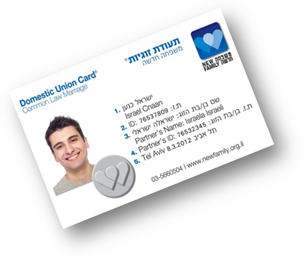
Legal Advice and Assistance

Who turns to New Family?
New Family gives legal advice and assistance to all kinds of families and couples: To married couples, common law couples, couples that had a civil wedding, couples in their second or third marriage, husbands and wives of different religions, to Israelis that are not Jewish and to foreign workers, to New Immigrants, same-sex couples and single-parent families.

What topics do we deal with?
- Marriage contracts, financial agreements, common life agreements, shared parenthood agreements
- Civil marriage ceremonies
- Couples of different religions or nationalities
- Divorce, alimony, wills, inheritance
- Children, surrogacy, adoption, single-parent families
- Registration of personal status in the Interior Ministry
- Biological wills
- Fertility treatments

Civil Marriages – Assistance and advice on all matters of civil marriage and its legal ramifications; financial agreements; assistance in the event of separation and divorce; registering in the Interior Ministry and the Population Registry; custody matters etc.

Married couples – Assistance and advice for couples married in the Rabbinate that nevertheless want to set financial agreements, pre-nuptials, common life agreements or agreements about the children’s future etc.

Common Law Couples – Advice and assistance on all kinds of agreements; financial agreements, couples agreements, common life agreements; confirmation through court or a notary; agreements about children, the status of the children, custody of the children; registration of the children’s family name; advice on mortgage rights, rights to pension, insurance, inheritance etc.

Remarried Couples – Advice and assistance for couples in their second (or more) partnership or marriage that want to arrange financial or common life agreements; advice on social and pension rights, children and the partner’s children, life insurances, wills, inheritance rights, future assets etc.

Mixed Marriages – Advice on marriage and divorce; financial agreements; registration in the Interior Ministry; paternity questions and registration of paternity; custody matters, alimony, guardianship, adoption of the partner’s children; registration of the children and receiving of residency rights, citizenship and social benefits etc.

Foreign Workers – Arranging of residency status for foreign workers with an Israeli spouse and for veteran foreign workers; marriage and divorce matters; couple agreements; custody matters, registration of children, paternity claims, adoption, guardianship etc.

New Immigrants – Marriage and divorce matters; advice on rights that arise because of marriage to a Jew or a relative of a Jew; clarification of Jewishness; child-related matters, children’s education etc.

Same-Sex Couples – Advice and assistance on all matters concerning the institutionalization of the relationship; couple agreements and confirmation through courts or through a notary; marriage registration; separation; adoption, surrogacy, guardianship etc.

Non-Jewish Partners – Arranging of status in Israel; couple agreements; child related matters and children’s registration; guardianship, adoption and surrogacy; economic, legal and social rights; family unifications etc.

Single-Parent Families – Advice and assistance on legal, social and economic rights; advice and assistance on fertility treatments and legal implications; guardianship; information about adoption etc.

Family Violence Victims – Legal advice concerning violence between family members

New Family’s expert lawyers give advice on all family matters. We give advice to families or individuals without regard to nationality, ethnicity, sex or sexual orientation.

Opening Hours:

Sunday to Thursday, 9:00 until 17:00
In our office at Nahmani St. 34, Tel Aviv
Tel. 03 - 5660504
Fax 03 - 5600720
E-mail:
newfamily@newfamily.org.il


Precedent-setting Rulings and Appeals

- Consular Marriages: In an appeal to the Supreme Court the Foreign Minister was requested to allow foreign consulates to hold civil marriages on their premises. The case ended in September 2007 in a settlement with the state, in which only those citizens that are not Jewish are entitled to use this arrangement.

- Precedent-setting ruling by Judge Natan Nahmani of the Ramat Gan family court regarding a petition that was submitted with the assistance of New Family. Two parents that gave an apartment as a gift to their mentally disabled daughter requested the return of this apartment. The parents claimed that they gave her a different apartment in exchange. The court decided that this was a legitimate exchange and confirmed that the gift should be returned to the parents. Ruling given on 28.10.2007.

- Historical breakthrough and achievement for New Family regarding a woman who did not receive a Get (Jewish divorce) from her husband but wanted to raise a new family and have a child anyway. The court allowed her to receive fertilization treatment with the sperm of a non-Jewish donor in order to prevent the children from being ‘bastards’. (According to Jewish religious law, the children of a married woman and a Jewish man that is not her husband are considered ‘bastards’.)

- Appeal to the Supreme Court regarding requirements for international adoption which limit the age of the adopting parents in contrast to the requirements for adoption in Israel.

- Appeal to the Supreme Court to abolish the requirement of confirmation of Jewishness on the part of New Immigrants that arrived after 1990 and declared to be Jewish.

- Appeal to the Supreme Court regarding a single woman unable to bear children who requests to use the services of a surrogate mother. To date, the law only entitles a couple of a man and a woman to surrogate services.

- Appeal to the Supreme Court regarding couples that the Rabbinate refused to marry on the grounds that one of the partners might not be Jewish (most of these cases involve New Immigrants)

- Same-sex couples: Several requests were submitted to the Ramat Gan family court to approve couple agreements for couples of two women or two men. Most of the agreements have been approved long ago.

- The Supreme Court equalized the status of women in common law relationships and civil marriages to that of women married according to religious law with regard to alimony. In addition, the Supreme Courte decided that men in common law relationships or civil marriages can also claim alimony from their spouses.


הוסף ל Facebook Share on Twitter הוסף ל Google Buzz הוסף ל Google Bookmarks הוסף ל HOTחדש

הוסף תגובה

שם מלא: *

אימייל:
(האימייל לא יפורסם בשום מקום באתר)
כותרת: *
תוכן: